




For many companies, real estate stopped being “one office” a long time ago. A headquarters in a business centre, warehouses, production sites, dozens of small locations across regions, several owned buildings. Every property comes with its own lease, its own landlord, its own meters, payments, floor areas and flow of employees.
As a rule, this portfolio is managed in Excel. Not because it is convenient, but because there is almost no ready-made tool for the job on the market. Up to a certain scale it works. The trouble starts when there are more than ten properties, and all the data about them sits in a single spreadsheet maintained by a single person.
In effect, such a company holds a property portfolio on the scale of a management company. The difference is that it is the tenant. And this is where a rarely voiced gap appears.
Real estate software was written for those who lease out. But those who lease in need to manage it too
The real estate software market has historically been built around the landlord: business centres, management companies, developers. For them there are lease accounting systems, rent billing, portals and tenant cabinets.
A large tenant with a distributed portfolio faces the same complexity, only from the other side of the table. The same leases, meters, areas, payments and people. The only thing missing is the counterparty. Which means the same class of system is required — a property register, obligation tracking, utilisation analytics — but tuned to the tenant’s interests rather than the landlord’s.
We propose a simple name for such a system: the tenant portal. A cabinet with no landlord in it — only the company, its properties and the full picture across them.
Where control is actually lost
Fragmented portfolio accounting is expensive in several places at once:
- Leases. Renewal dates, indexation dates, early exit terms, rate recalculation formulas — all critical for the budget, yet usually kept in one employee’s head and in one file. When that person leaves, the knowledge goes with them.
- Meters. Readings across dozens of properties have to be collected, submitted and reconciled. A single missed reading means a disputed charge and an overpayment noticed months later.
- Payments. Rent, operating expenses, utilities, parking — for every property, every month. Reconciling this against the budget and spotting where the overpayment occurs manually only works in firefighting mode.
- Floor areas. A company usually knows exactly how many square metres it leases, and almost never how many of them are actually used.
- Attendance. Access control data exists at each site separately, but is consolidated nowhere. As a result there is no answer to the basic question: which offices are genuinely busy and which are kept “just in case”.
- Facility requests. Employee requests from different sites arrive via messengers, email and verbally. They get lost, duplicated, and carry neither status nor deadline — while the facilities team looks inefficient, although the real cause is the absence of a single channel.
Each item on its own can be handled “manually”. The problem is not the processes — it is that there is no single place for them.
A single portal: what it brings together
The idea behind the product is to bring the entire portfolio (leased and owned properties, offices, warehouses, remote locations) into one system with a single entry point, instead of a dozen spreadsheets and chats.
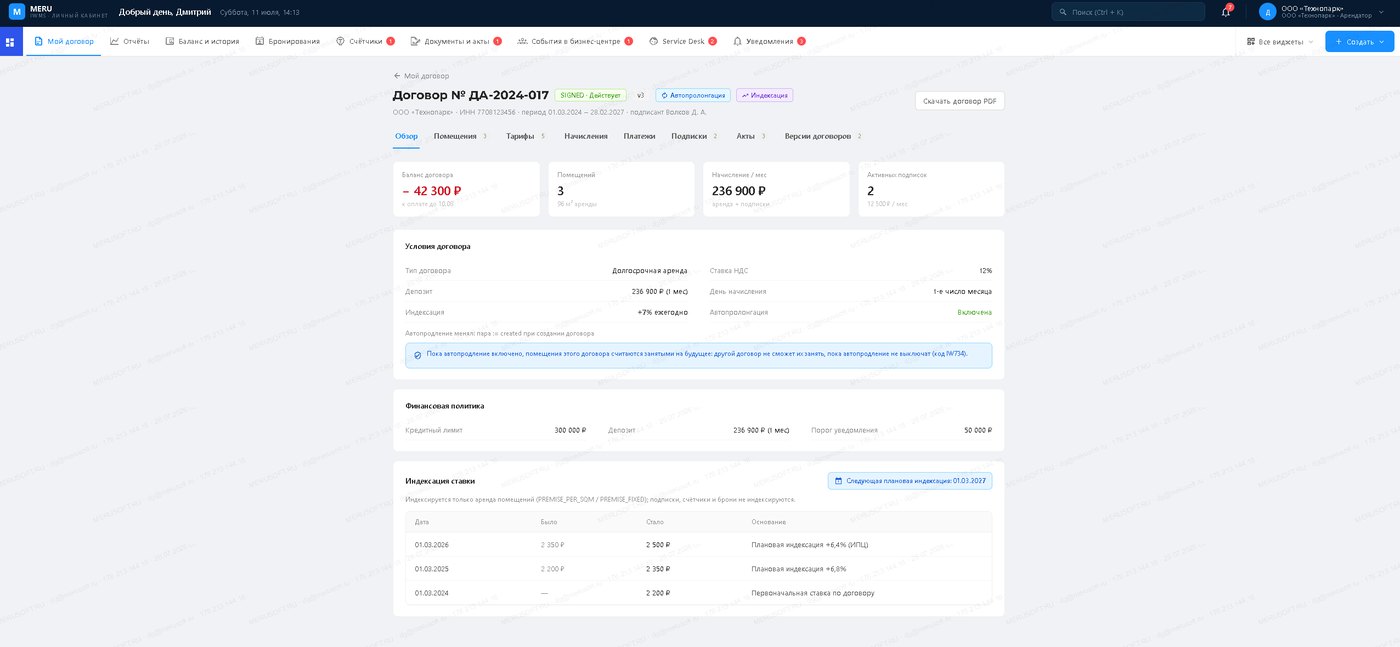
Key modules:
- Property and lease register. All properties on a map and in a list: address, landlord, area, term, rate, indexation, key dates. The system notifies you well in advance about renewals, indexation and exit windows.
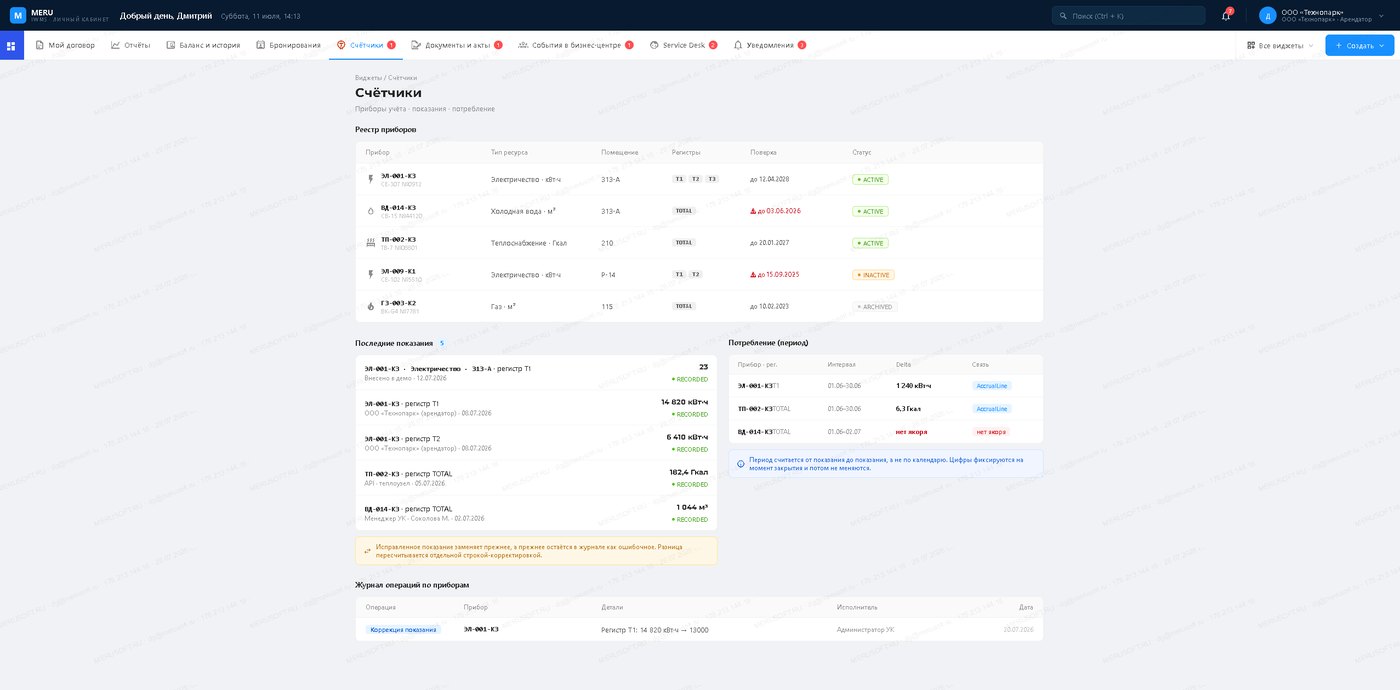
- Meter and utility accounting. Readings for all properties in one place, history, submission reminders, control over abnormal spikes.
- Payments and budget. Charges and payments per property, plan versus actual, integration with 1C. The cost structure and saving opportunities become visible.
- Floor areas and their actual use. Not only “how much we lease”, but “how much actually works”.
- Attendance analytics from access control data. Anonymised entry data from all sites brought together on one screen — with a clear picture of how busy each location is.
- Facility service desk per property. An employee request in a few clicks, routing to the responsible person, statuses and deadlines. It is transparent what is happening where, how fast it is resolved and what it costs per property.
Real estate is the second largest cost after payroll — and the least transparent
For most companies, property costs are second only to payroll. Yet they are the hardest to control: you can pay for an office with 200 workplaces that 60 people show up to on a weekday — for years, if nobody measures utilisation.
Two instruments work together here:
- Access control data gives the continuous picture: which properties are genuinely alive and which are maintained without real load.
- A workspace utilisation audit gives a deep one-off snapshot: how many workplaces and meeting rooms are in use, where there is excess, where there is a shortage, what can be reduced or reconfigured.
This is exactly how the typical request from large companies takes shape: first, assess what exists and how it is used (an office map, an audit); then obtain a tool for the ongoing management of that portfolio. We are running one such project for a company with a portfolio of hundreds of properties and hundreds of thousands of square metres. And the starting point is almost always the same — an Excel spreadsheet.
Why this matters now
- Real estate is being recalculated. Companies are revisiting the volume and structure of leased space, and that conversation cannot happen without data.
- Lease accounting has become mandatory. The Russian FSBU 25/2018 standard moved lease and payment discipline from “nice to have” to the norm. Maintaining it in spreadsheets is getting harder.
- Import substitution. Western systems of this class have left the market or become risky. Merusoft is a Russian software developer, its products are listed in the Russian Software Registry; where security requirements are elevated, on-premise deployment on the customer’s infrastructure is possible.
We are extending the platform towards the tenant
All the key components of this solution are already running in production at Merusoft: access control integrations, workspace utilisation audits, the office map, lease and payment accounting, portals and the service desk. We are now combining them into a single tenant portal for distributed portfolios — a logical extension of the SmartOffice platform towards those who do not lease property out, but lease and operate it.
This is not an experiment from scratch, but an extension of proven functionality. That is why implementation is faster than bespoke development: the core modules are ready, and the task is to configure them for the structure of your portfolio and connect your data sources.
The product is worth considering for companies that recognise their own situation in this description:
- dozens of properties tracked in a single spreadsheet;
- no clear understanding of which offices are actually used;
- facility requests scattered across chats and email;
- consolidating payments across all properties is a quarterly manual effort.
If this describes your company, it is worth considering an implementation before the task grows by another dozen properties.
See how it works
A detailed product description, the list of modules and implementation scenarios are available on the Tenant Portal page.
Next step — a short meeting
If these portfolio management challenges sound familiar, we invite you to take a closer look at our system as a tool that can close them. With no commitment: you can start with a short conversation about the structure of your portfolio and, if it looks relevant, see how the solution works on your real data.
Leave your contact details — we will get in touch within one business day and suggest a convenient time.
Merusoft · info@merusoft.ru · +7 495 545-32-84