People come in only on some days, no desk is assigned to them, and archive and storage rooms have been cut back. Yet the laptop, the documents, the gym kit and the personal items have not gone anywhere — there is simply nowhere safe to put them. Every role sees this problem from a different angle.
Laptop, charger, headset, a folder of documents, gym kit. On an office day, half the effort goes into finding somewhere to put it all — and then into not leaving it unattended after lunch.
Issuing and collecting keys, duplicates, forced openings, arguments about who took whose locker. The occupancy spreadsheet is out of date within a week, and some lockers have been assigned for years to people who left long ago.
Mandating attendance is easier than making the trip worth it. Everyday details — where to put your things, where to change after cycling in, how to receive a delivery — shape attitudes to the office more than any policy does.
A clear-desk policy does not work if no desk is assigned and there is nothing to lock. Who opened a locker and what was inside cannot be reconstructed: a mechanical key keeps no log.
The locker stops being a metal box with a key and becomes a service: the company gives people secure storage and a way to hand things over without matching anyone's calendar.
Laptop, dock, folders, a change of clothes, an umbrella. People can come in empty-handed, and confidential paperwork does not travel across town in a backpack.
Originals, the company stamp, equipment: put them in a locker and send the code to the recipient. Your colleague collects them whenever they come in — even if you are working from home that day.
Documents from a counterparty, an order, a parcel: the courier opens a locker with a single-use code and leaves. Reception does not turn into a storeroom and nothing goes missing.
Your own locker on your floor, a locker in another company office for the length of a visit, a locker in the corporate gym — all in one app and on one badge.
Rules are set per group of lockers and can be mixed within one bank. Sharing is only one of the options: if people need assigned lockers, the lockers stay assigned — just without keys, duplicates and manual bookkeeping.
The locker is assigned as before, but it opens with a phone or a badge — no more keys to issue or lose.
For a colleague from another city, a contractor, a new hire, a project member — access for exactly as long as needed.
For the gym, flexible-desk zones or shift teams, lockers need not be assigned at all: people take a free one and release it when they leave.
Each locker bank belongs to its location, while the rules, the app and the reporting are shared: an employee sees only the lockers they have access to, and facilities manage every bank from one place.
A bank by the lifts or in the break area: laptop, documents, personal items. The locker sits close to where the person usually works.
Travelling to another office or city, the person gets a locker for the duration of the visit. No separate request, no local administrator.
Lockers in the changing room work on the same badge, usually from a shared pool: take a free one for the workout, release it on the way out.
Lockers by the entrance: a courier drops off with a guest code, a colleague collects with their own. Reception and security are out of the loop.
IT puts a laptop, a headset or a loaner device into a locker and sends the code to the recipient. No meeting, no signature — and the opening is in the log.
Shift teams, workwear and tools, cycling helmets and a change of shoes: tall lockers near the showers or the entrance from the car park.
Security can see who opened a locker and when, so disputes are settled with facts rather than by asking around. Facilities stop collecting data by hand: occupancy by office, floor, bank and locker size is calculated automatically.
Together with the office utilisation audit locker data joins the bigger picture: desk, meeting room and storage usage are measured by the same method.
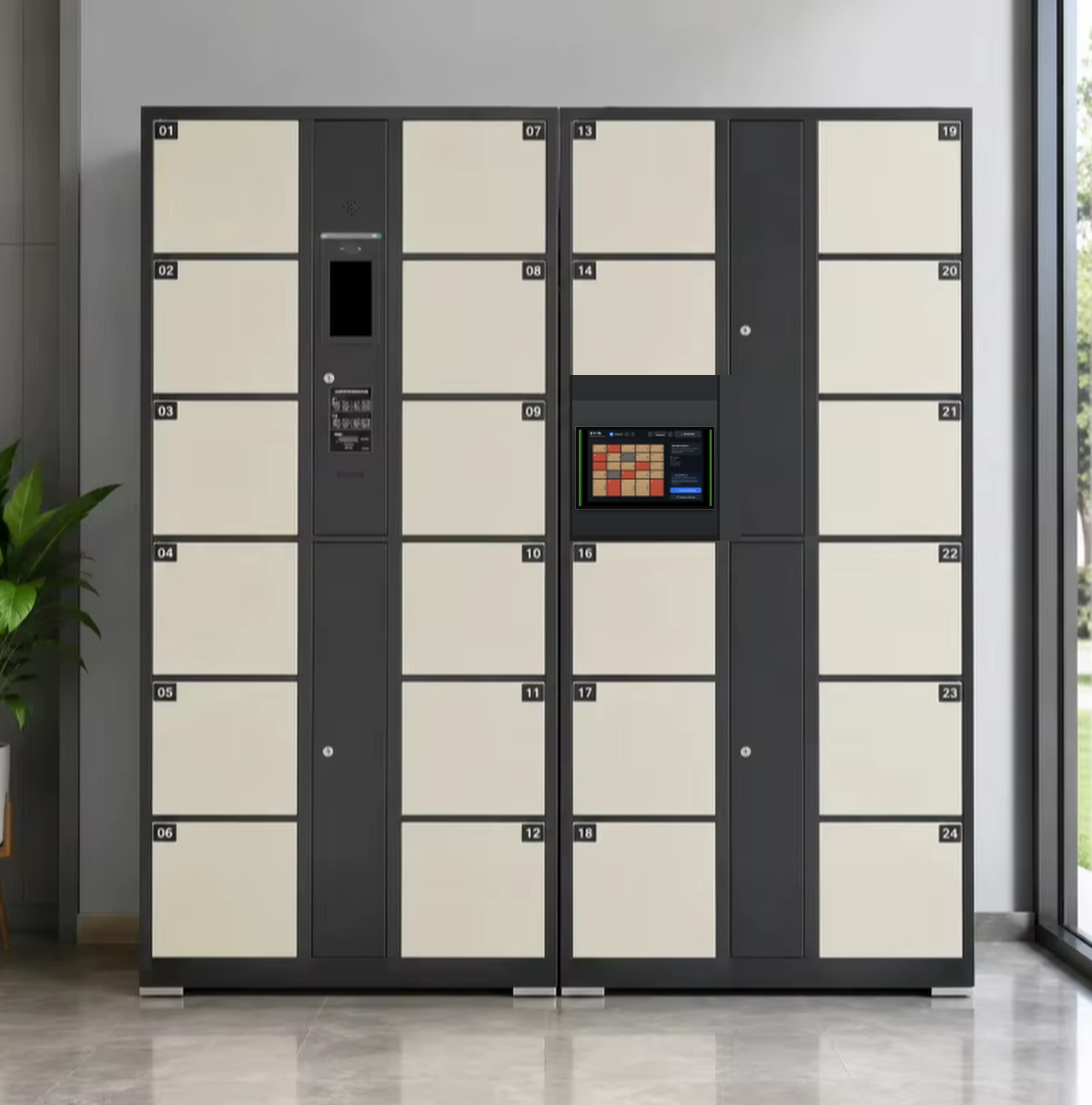
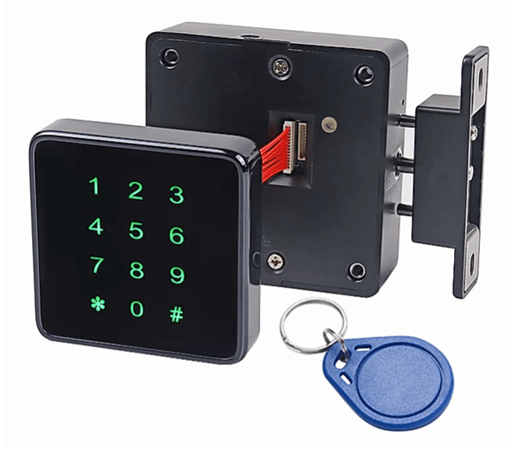
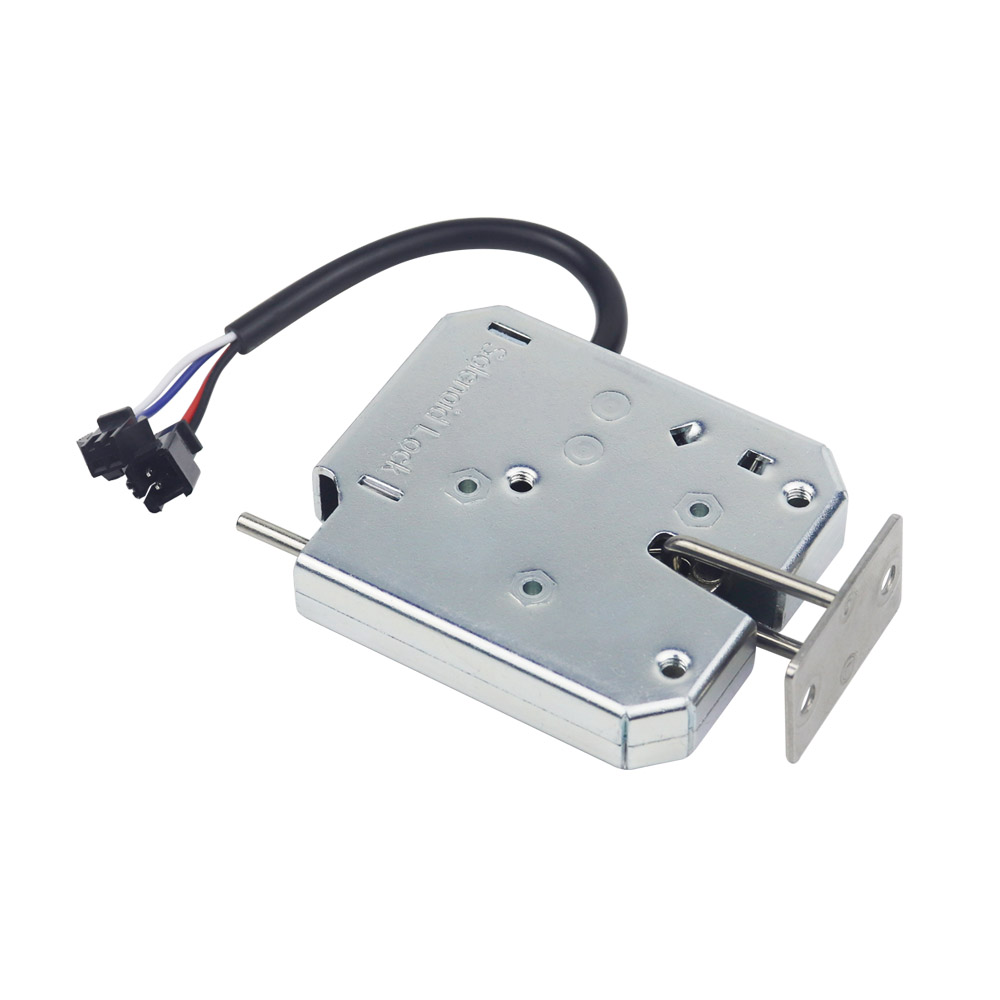
Most offices already have the furniture, and there is no reason to replace it: wireless locks fit existing doors with no cabling. If a new bank is needed, we supply the whole thing.
Lockers live in the same system where people book desks and meeting rooms: one employee directory, one badge, one app and shared workplace analytics.
No. Permanent assignment is a full-fledged mode: the locker stays personal, only the way it is opened and tracked changes. A shared pool is an option for specific groups of lockers, for example in the gym or in flexible-desk areas.
No. Wireless locks are installed on the furniture you have with no cabling — an existing bank is brought into the system in a single visit. New cabinets are only needed if there are physically too few lockers.
The locker holder sends the recipient a code or a QR — to an employee's account, or as single-use guest access for a courier or contractor. Every opening is recorded: you can see who put something in and who took it out.
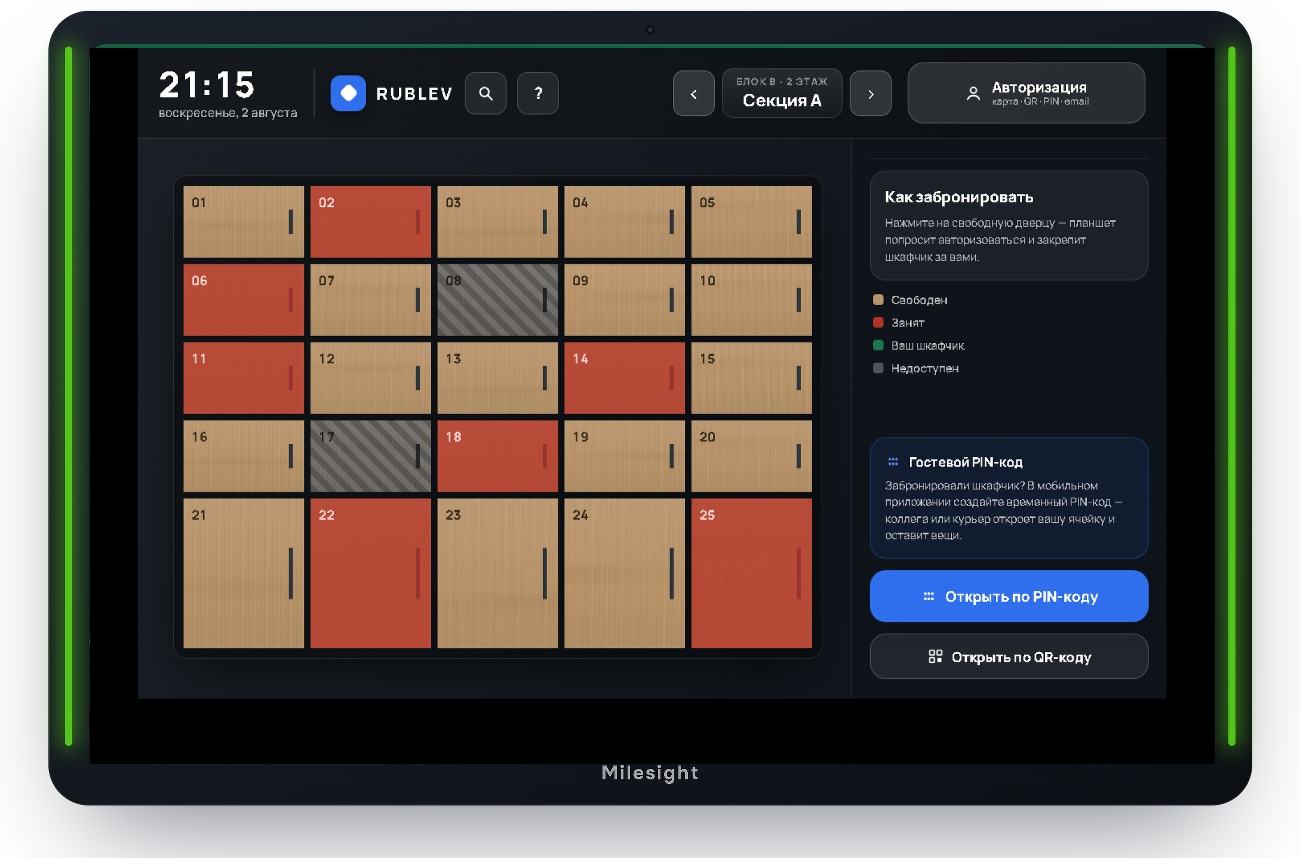
The access methods work in parallel: access card, PIN, QR or email on the tablet by the cabinet. One is enough — the no-smartphone scenario works end to end.
Access is revoked together with the badge, based on HR data. The locker goes into a report for checking and returns to the pool. There are no key duplicates to chase, because there are no keys.
The controller and the tablet keep working offline: card and PIN access continues, events are stored locally and sync once the connection is back.
We start with one bank in your office: fit locks to the existing lockers, connect the tablet and the app, and after a month look at the log and the occupancy — then decide how to scale across floors, offices and the gym.